
Key Information
- If you have any questions about the project, contact us at newyjfacility@decyp.tas.gov.au or phone (03) 6165 0443.
About the new Tasmanian Youth Justice Facility
Why is the Tasmanian Government doing this?
We want to improve community safety and the lives of children and young people who are in detention.
As part of the response to the Commission of Inquiry, there was a commitment to close the Ashley Youth Detention Centre as soon as possible and build a new secure facility. The new Tasmanian Youth Justice Facility is designed to be small and homelike and promote a safe environment for children and young people and trusting relationships with staff.
This approach is part of broader youth justice reforms moving to a therapeutic model that focuses on early intervention, prevention and rehabilitation, with detention as a last resort. While the facility will provide secure accommodation for those who need it, its purpose is rehabilitation that focusses on interventions that support the safety and wellbeing of young people.
How is youth justice being reformed?
We are reforming our Youth Justice portfolio to build a system of therapeutic, community-based services that help prevent young people from reoffending and keep them out of detention where possible. This includes working with various service providers to offer early intervention, support for bail and rehabilitation services.
What is the role of the new facility?
The new facility will play a role in the broader reforms to Tasmania’s youth justice system. The focus of the reforms is on diversion and early intervention, with detention always being a last resort. The new facility will focus on providing care for the small number of children and young people who need secure accommodation, within a therapeutic, trauma-informed and culturally safe environment.
What will the new facility be called?
The temporary name for the new facility is the Tasmanian Youth Justice Facility. The dedicated name of the new facility is still to be confirmed. The dedicated name will be selected in consultation with key stakeholders and will be confirmed before the new facility is complete.
How much funding has been provided for the new facility?
The Tasmanian Government allocated $50 million in the 2023-24 State Budget for the development of the facility. The budget for 2025-26 will be confirmed when it is approved by Parliament.
The 2025-26 Budget included additional funding of $105.3 million over the 2025-26 Budget and Forward Estimates for the development of new Youth Justice Facilities to replace the Ashley Youth Detention Centre, bringing the total commitment to $155.3 million.
How many young people will the facility accommodate?
Accommodation for up to 16 children and young people will be provided in the facility. This includes two three-bedroom houses, two four-bedroom houses, and one two-bedroom house that can also act as two one-bedroom studios.
In addition, there are four beds in the health and admissions building for health and orientation, for a total of 20 beds on site.
An additional four bed house was included in the Development Application but is not currently funded for construction. This has been included in the Development Application as a forward planning measure, enabling the facility to be expanded if required.
This responds to consultation feedback about possible long-term demand, ensuring that this limited expansion could proceed without the need for further planning approval.
How does the facility promote rehabilitation and reduce offending?
The facility is designed to support rehabilitation by creating a safe, respectful, and therapeutic environment that addresses the underlying factors contributing to a young person’s involvement in the justice system.
Key features that support rehabilitation and reduce reoffending include the therapeutic design of the facility which will reflect a trauma-informed approach, with calm, home-like spaces that help build trust, emotional regulation, and a sense of stability.
Importantly, children and young people will have access to education programs, life skills development, and vocational training to support them in becoming well-adjusted, resilient teenagers who can stay safe and engage positively with their community.
The facility will also incorporate culturally appropriate spaces and programs, particularly for Aboriginal children and young people, to strengthen identity and community ties and connection to Country.
On-site health and mental health services will be available to address individual needs and support positive behavioural change.
The overall goal is to support children and young people to build the skills, confidence and relationships they need to lead positive lives when they return to the community.
Why was this location chosen?
The Department for Education, Children and Young People (DECYP) undertook public consultation in 2023 to help inform the site selection process. Stakeholders and the community had the opportunity to provide their feedback on two (2) shortlisted sites for a new facility (one in Pontville, and one in Risdon).
Based on feedback received through the public consultation and the final report from the Commission of Inquiry, the preferred site for the new facility was chosen to be 466 Brighton Road, Pontville. The Community Engagement Outcomes Report provides an overview of the public consultation.
Several feasibility investigations were completed to help determine the chosen site’s suitability for the new facility. Those investigations included:
- Aboriginal cultural heritage assessments
- Natural values assessments
- Noise monitoring
- Geotechnical assessments, and
- Infrastructure feasibility assessments.
The assessments took 12 months to complete and involved a range of on-site investigations, research, reporting, and consideration of the final recommendations by the Tasmanian Government.
What about impacts from nearby activities or businesses on the new facility?
The project and design teams are working with nearby landowners, residents and businesses to manage external factors such as noise and odour that may impact the site.
What about the impacts from cannabis odour?
The Department is aware that cannabis odour from the Tasmanian Botanics site nearby can be evident from time to time.
The project team has been working with Tasmanian Botanics on alternative mechanisms for waste disposal that eliminate odours from current incineration practices.
The operator, under their licence with the Commonwealth, are required to dispose of waste. Any alternative disposal technique requires approval from the Office of Drug Control (Commonwealth).
Piloting of alternative technologies has been completed by the operator, and approval has been sought for an alternative disposal technique.
Does this development impact Aboriginal culture or heritage values?
The new facility is intended to be co-designed with Tasmanian Aboriginal people and include culturally enriching environments for Aboriginal children and young people that promote connection to family, community and Country.
During the assessment phase, an Aboriginal heritage assessment and sub-surface investigation was completed. The results of these assessments will be used to guide the design of the new facility to ensure any Aboriginal heritage is managed appropriately.
We recognise the over-representation of Aboriginal children and young people in the youth justice system. An Aboriginal Reference Group has been established and will work closely with Aboriginal youth justice organisations and people, across the range of Commission of Inquiry reforms, including specific aspects of the design and use of the new facility.
What about impacts to the surrounding area and community?
The size of the site gives the opportunity to create a large buffer between the facility and surrounding properties, including use of vegetation to provide visual screening.
There will be works at the entrance of the site to allow access, which may impact nearby roads. Any works that impact access to nearby streets, roads or footpaths will be managed in a way required by the relevant road authority.
The new facility is not expected to significantly increase traffic in the local area.
What about impacts to property values in the area?
Research conducted by Queensland Corrective Services (QCS) on Correctional Centres in Queensland, New South Wales and the Australian Capital Territory found that the increase in investment and infrastructure associated with custodial institutions results in more investor confidence and increasing property values as staff move into the area looking for housing.
No studies of property values have been undertaken in Tasmania. Past experience from other jurisdictions, such as New South Wales, has shown concerns on the impacts to property prices were not realised.
How does the facility respond to the Commission of Inquiry?
The new facility is a commitment made in response to the Commission of Inquiry. The new facility will play a role in the broader reforms to Tasmania’s youth justice system recommended by the Commission of Inquiry in Chapter 12 of its report.
The focus of the reforms is on diversion and early intervention, with detention always being a last resort. The new facility will focus on providing care for the small number of children and young people who need secure accommodation, within a therapeutic, trauma-informed and culturally safe environment.
The proposed buildings can be described as small and homelike to assist in the approach of providing for a normalised, trauma-informed and therapeutic design.
Parts of the facility that are designed to assist in the rehabilitation of children and young people include:
- Spaces to interact with nature to improve health and wellbeing.
- Rooms with access to natural light and views to the surrounding landscape.
- Spaces that support children and young people to have normalised daily routines.
- Programs that give children and young people an opportunity to adjust into society upon release.
If there is a focus on being tougher on youth crime, why are you building a facility that focuses on rehabilitation instead of punishment?
Research shows that rehabilitation, when provided in a secure, structured setting, helps stop children and young people from reoffending.
The new facility will work intensively to change the behaviours that led those children and young people to offend in the first place.
How does a therapeutic facility stop repeat offenders or serious crimes?
The new facility tackles the root causes of offending such as trauma, substance abuse, or disengagement with education, while also imposing structure, boundaries, and supervision.
By changing behaviour and improving life outcomes, it reduces the likelihood of future offending behaviour.
Is the facility secure enough to deal with children and young people who commit violent or serious offences?
Yes. The facility is being designed with modern security infrastructure, 24/7 staffing, and clear procedures to manage risk. It will be able to accommodate children and young people who have committed serious offences in a safe and controlled environment.
Is the proposed facility in alignment with Child Safety Policy and COI Recommendations?
The Tasmanian Government is committed to developing a youth justice system that achieves better outcomes for young people and their families and keeps our community safe.
The new facility design responds directly to recommendations made by the Commission of Inquiry (CoI) as confirmed by the Child Safety Reform Implementation Monitor, the Hon Robert Benjamin AM KC, in a statement released on 7 November 2025, which can be accessed via the Monitor’s website. The Monitor’s statement confirmed that designing and planning efforts for the new facility “are likely to meet the recommendations of the COI.”
The Monitor also noted in his statement that the new facility “is part of a significant jigsaw of reforms contained in Recommendations 12.1 to 12.39 of the COI.
The COI report included significant narrative about the design, culture, model of care and operation of such a facility. This has informed the development of the new facility and alongside the recommendations has been integral to the design and decisions being made across all aspects.
The development of the new facility forms part of a broader reform program to improve youth justice outcomes across Tasmania.
This will include:
- a greater focus on prevention and early intervention
- additional options to divert young people away from the formal court system, including designing an assisted bail and transition from detention system, including exploring accommodation options
- a broader range of community-based sentencing options available to courts
- trauma informed, therapeutic and restorative interventions for high-risk young offenders, including a new smaller youth justice facility
- investing $1.5 million to support innovative local initiatives and partnerships that target the root causes of youth offending in local communities and engage children and young people in education, training, employment, sport, and the arts.
While noting that custodial sentences should be imposed as a last resort and for the minimum time necessary, the COI recognised secure detention was a necessary part of Tasmania’s youth justice system. This is intended as a last resort for children and young people who commit the most serious offences, and to ensure community safety.
Why is only one facility being proposed?
The CoI noted that ‘the small Tasmanian youth detention population may not justify multiple detention facilities.’
The current project focuses on the delivery of the youth justice facility in the south only. The Youth Justice Blueprint outlines that this facility will work alongside community-based care, including supported accommodation and bail-assisted options.
The Department for Education, Children and Young People is exploring options to deliver these services including working with the community sector to develop options that do not require new facilities to be built.
Why can’t the Ashley Youth Detention Centre be upgraded, or the new facility located at another site?
Multiple expert reviews, and most importantly the Commission of Inquiry, have concluded that the Ashley Youth Detention Centre is fundamentally unsuitable, even with upgrades.
Its layout, age, and history cannot deliver the therapeutic environment required by modern youth justice practice.
The Government has accepted the recommendations of the Commission of Inquiry, which included the closure of the Ashley Youth Detention Centre.
Redeveloping the Ashley Youth Detention Centre would be inconsistent with the Government’s commitment to implement those recommendations and to fundamentally reform Tasmania’s youth justice system.
Alternative locations were assessed and the current site was selected following extensive investigation, community consultation, and site investigations.
The need to replace the Ashley Youth Detention Centre is urgent, and the current site remains the most suitable option identified to date.
How will connections between children, young people and their families be supported?
The facility and its corresponding Model of Care is being designed with clear objectives to improve family connection. The project acknowledges the importance of maintaining connections with families and are considering transport and access supports as appropriate.
The site provides access to Hobart’s health and specialist services. The alternative of a highly remote site would create greater challenges, especially for legal access, health care, education and staffing. The site choice represents a balance between accessibility, privacy, safety and therapeutic outcomes.
Designing the new facility
What will the buildings look like?
The Development Application includes drawings of the new Facility which will be made public during the exhibition of the Development Application by the Southern Midlands Council.
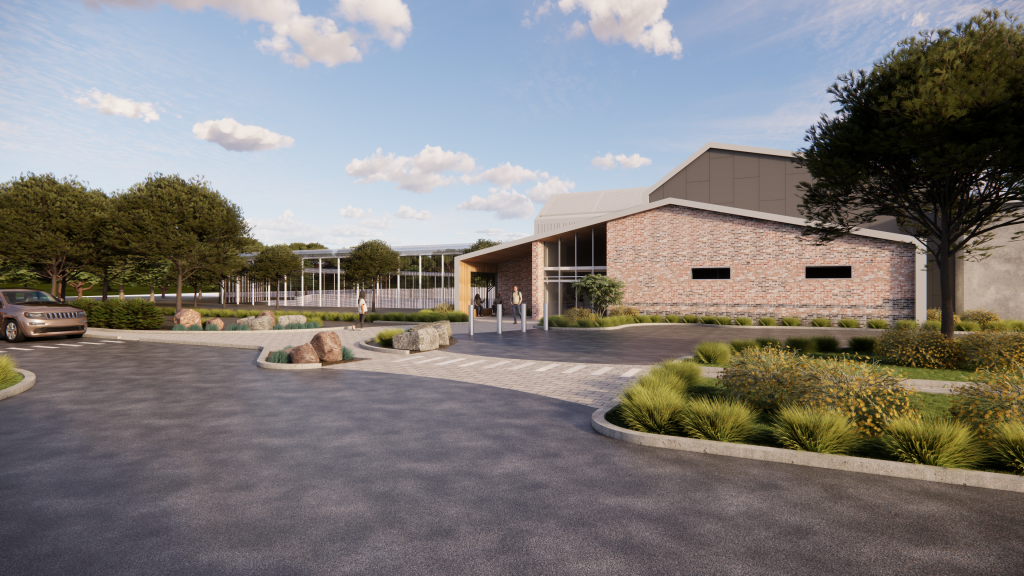
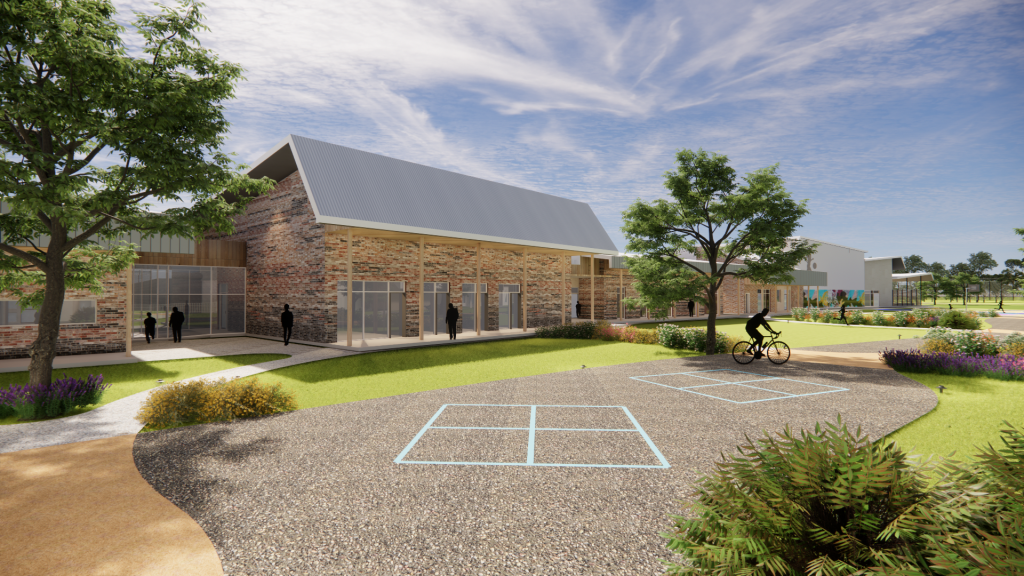
The buildings are designed to create a welcoming and non-institutional atmosphere for children and young people. The buildings will use materials like brick and timber (or timber looking), emphasising a sense of familiarity and warmth. Buildings will feature angled roofs which were chosen through ongoing design development, informed by operational needs, stakeholder input, and best practices in youth justice facility design.
The below images provide an artist’s impression of the facilities as represented in the Development Application.
Who is designing the new facility?
Grieve Gillett Architect have been appointed as the Lead Design Consultant to design the new facility. They are based in Adelaide and have specific experience designing similar facilities. They are supported by Guymer Bailey Architects (Melbourne) and X-Squared Architects (Hobart) together with a broader team of sub-consultants.
These specialist consultants and contractors will make sure the facility meets the highest standards of therapeutic and secure care and minimise disruption to neighbouring residents and land users.
What is included in the new facility?
The new facility includes a range of spaces which are typical of a modern youth justice facility, such as:
- An Entry building (including secure entry).
- A health centre, together with an admission building, providing health and mental health support such as GPs, counselling spaces and other allied health support.
- Administrative areas for staff.
- A visitor area with a small café and central kitchen servicing children and young people, staff, family and visitors that come to the site.
- An education building with teaching spaces to support ongoing education and learning.
- Recreation facilities for structured physical activity and movement.
- A cultural centre and garden, which will provide greater opportunity for connection to family, community and country.
- Accommodation for up to 20 children and young people will be provided in the facility under the proposal the Development Application. This includes two three-bedroom houses, three four-bedroom houses, and one two-bedroom house that can also act as two one-bedroom studios.
- In addition, there are four beds in the health and admissions building for health and orientation.
- The Development Application includes four more beds than outlined in the Masterplan that was released. While these beds are not currently funded for construction, they have been included in the plans as a forward planning measure, enabling the facility to be expanded if required.
- This responds to consultation feedback about possible long-term demand, ensuring that this limited expansion could proceed without the need for further planning approval.
- The houses will have a residential style kitchen, living and dining spaces, and laundry facilities so that the young people can cook, clean and live in a normalised environment together with staff overseeing their care.
- The houses will also have a multi-purpose space which can be used for education, health services or counselling.
How is the site accessed?
The site will be accessed from Rifle Range Road which provides for a more discreet and controlled entry. Rifle Range Road will be upgraded to support this use.
The existing access off Brighton Road will continue to be used for agricultural activities, like how it is used now.
How is security incorporated within the design?
The new facility is part of broader youth justice reforms moving towards a therapeutic model that focuses on early intervention, prevention and rehabilitation, with detention within a secure facility as a last resort.
The site incorporates a secure perimeter, as well as internal fencing to differentiate between visitor zones and those for young people.
The ‘building as perimeter’ model comprises a combination of fencing and buildings forming the secure perimeter of the Facility. Fence materials include anti-climb mesh fencing with secure anti-climb tops.
Where buildings form the part of the perimeter, their external wall will be made from pre-cast concrete with steel framed windows and high security glazing.
The design and layout of the buildings allows for extensive sight lines across the facility, and passive supervision across the site. There are multiple pedestrian routes across the site to enable staff to manage and move young people safely within the facility.
There will also be external secure courtyards associated with each residential building that sit on the boundary with a tensioned mesh ‘roof’.
The fencing will be located some 200 metres from the nearest private properties.
There will be extensive CCTV coverage across the site, as well as movement detection radar technology.
Will there be perimeter lighting?
Perimeter lighting will be positioned along site fencing. The lighting system will be motion-activated through a control system which dims the lights when not required. Parking and entryways will be well lit for staff and visitor safety.
Recreation areas will have LED light fixtures with timer controls to ensure safe movement when required.
How is the design of this Facility any different than the Ashley Youth Detention Centre?
The design intentionally avoids the harsh, punitive built form associated with older detention models, with living units resembling small, domestic-scale accommodation.
Outdoor areas have been created for therapeutic, recreational, and cultural activities, not confinement.
Internal movement is planned to be calm and supervised, supporting emotional regulation.
Natural materials, colour palettes, and landscaping are used to reduce institutional feel.
The design direction has been shaped through significant engagement and consideration of trauma-informed care and youth development needs.
Construction and operation of the new facility
When will the new facility be constructed?
The new facility is targeted for completion as soon as possible in 2027, subject to receipt of planning approvals, detailed planning and procurement.
Who is constructing the new facility?
Qualified contractors will be procured through a tender process to build the new facility.
How will traffic (construction or operation) impact our neighbourhood?
Traffic is an important concern for local residents and minimising impacts during both construction and operation of the facility is a key commitment.
During construction, a traffic management plan will be developed to safely manage construction vehicle movements and reduce disruption to local roads. Construction hours will be managed to avoid peak local traffic times and reduce noise and congestion.
Once the facility is operating the number of daily vehicle movements is expected to be relatively low. The facility will not generate high volumes of traffic like a school or shopping centre.
On-site parking will be provided for staff and visitors, reducing the need for street parking.
The Project Team will continue to work closely with the local council to ensure any impacts are managed responsibly and transparently. Community feedback on local traffic concerns is also welcome as part of the planning process.
Will local businesses or workers be engaged in the project?
Yes. Supporting local businesses and creating local job opportunities is a priority. The Project Team will be working to ensure that:
- Local businesses are given fair opportunities to tender for work, including suppliers, subcontractors, and service providers.
- Local workers are considered wherever possible during both the construction and operational phases of the facility.
- Apprenticeships and traineeships are encouraged as part of the construction process to support skills development in the local workforce.
In addition, ways the operating model of the facility can provide longer-term opportunities for local employment and partnerships with community organisations and service providers will be explored.
We want to ensure that the project delivers broader economic and social benefits for the surrounding community, not just through the construction of the facility itself, but through the way it’s operated.
Model of Care
What is the new Tasmanian Youth Justice Facility Model of Care?
A model of care is a framework for guiding best practice delivery of services for a person or population.
The new Tasmanian Youth Justice Facility Model of Care (new facility Model of Care) will describe how youth justice services will be delivered for children and young people in detention at the new facility, from arrival to leaving and transitioning back to their community. This will be a foundational document for the new facility, which will inform all aspects of operations, practice and service delivery.
The new facility Model of Care is informed by, and supports, the Youth Justice Blueprint and Youth Justice Model of Care which provides the overarching approach, principles and ways of working for services to support children and young people across the wider youth justice system.
More information about the new facility Model of Care will be released in early 2026.
How will the facility Model of Care reduce reoffending?
The aim of the new facility Model of Care is to identify and address the needs of children and young people by providing safe and secure care, education, services and programs that meet their needs and support them to address their offending behaviour.
The wellbeing and rehabilitation-oriented approach is believed to be more effective at addressing social and criminogenic needs and therefore reducing reoffending rates. Within this approach, accountability for the wrongdoing is a focus. This includes children and young people receiving support to develop an understanding of the impact of the harm caused to victims and to engage in opportunities for reparation and restoration.
Those working alongside them will support them, and their families, to access wider system and community supports, increasing the chances of children and young people returning and remaining successfully in the community.
Will there be transport options for families and visitors?
The new facility Model of Care recognises connection to families, friends and broader supports in the community as important for supporting and children and young people in detention and improving outcomes upon their release.
Making the facility as accessible as possible is important and the Project Team will continue to engage with the community and stakeholders to work through transport options in more detail.
What kind of support will young people receive at the new facility?
The new facility will provide a range of therapeutic and practical supports tailored to each young person’s needs. This includes:
- access to education,
- mental health care,
- drug and alcohol services,
- cultural support, and
- life skills development.
The goal is to help children and young people address the issues that led them into the justice system and build a foundation for a positive future.
Will the facility include education and training programs?
Yes. Education is a key part of the new facility Model of Care. Young people will be supported to continue or re-engage with their education while in the new facility, including school-based learning and vocational training. Programs will be flexible to suit different learning levels and help prepare young people for employment or further study when they return to the community.
How are health and mental health needs addressed in the facility?
Young people expected to enter the new Facility will often have complex health and mental health needs. The facility will include access to on-site or visiting health professionals including psychologists, counsellors, nurses, and general practitioners. A trauma-informed approach underpins the new facility Model of Care, meaning staff are trained to respond with empathy and to support emotional and psychological healing.
Will there be cultural support for Aboriginal children and young people?
Yes. Cultural safety is a central part of the new facility. The design of the Facility will include dedicated cultural spaces to enable Aboriginal staff, Elders, and community organisations to provide specific programs to support Aboriginal children and young people within the facility. Culturally responsive programs aim to strengthen identity, belonging, and connection to culture and country.
Community consultation and feedback
How were community members consulted in the development of the Masterplan?
The project team engaged directly with key stakeholders, landowners and representatives from the Tasmanian Aboriginal community during the development of the Masterplan. This provided an important opportunity to gather feedback and understand any concerns related to the design of the facility and its operation.
What happened with the feedback I provided on the Masterplan?
A Community Consultation and Feedback Summary Report [PDF,1.15MB] has been prepared that provides a summary of the feedback received during consultation on the Masterplan, and how this has been responded to.
How will the community be kept informed as the project progresses?
The project team will continue to engage with key stakeholders and landowners as the design and development of the facility progresses and provide regular updates on the project website.
If you have any questions about the project, please get in touch with our Stakeholder Engagement team at ERA Advisory on (03) 6165 0443 or by email at newyjfacility@decyp.tas.gov.au.
When will the Council make a decision on the Development Application?
Council assessed the Development Application against the Tasmanian Planning Scheme in accordance with Land Use and Planning Approvals Act 1993. The Development Application has now been approved, and a planning permit has been issued.
An appeal period is now open for those parties with a right of appeal. Appeals must be lodged with the Tasmanian Civil & Administrative Appeals Tribunal (TASCAT) during the appeal period.
The Resource & Planning Stream of TASCAT can be contacted by email resourceplanning@tascat.tas.gov.au, by phone: 1800 657 500 or via their website: www.tascat.tas.gov.au
The original inhabitants of Tasmania were Aboriginal people. For this reason, throughout this document, the term Aboriginal is used to represent both Aboriginal and Torres Strait Islander peoples, acknowledging that Aboriginal and Torres Strait Islander children, young people and families for who Tasmania is home.
Further Information
If you have any questions or would like further information, please contact us.
- Postal Address:
New Tasmanian Youth Justice Facility
GPO Box 123, HOBART, TASMANIA 7001 - Email: newyjfacility@decyp.tas.gov.au
- Phone: (03) 6165 0443