
We know that the best results come when we learn from each other, share expertise and adopt the best ideas from around the world – while supporting teachers and school leaders to focus on what matters most: student learning and wellbeing.
That is why we are trialling the internationally proven Multi-School Organisations (MSO) model as part of our education system reform.
This reform is in line with a finding from the 2024 Independent Education Review (the Review). The Review found that we should trial new ways of organising schools so they can share resources and services. It also found that there is merit in trailing Multi-School Organisations.
What does this mean for Term 1 2026?
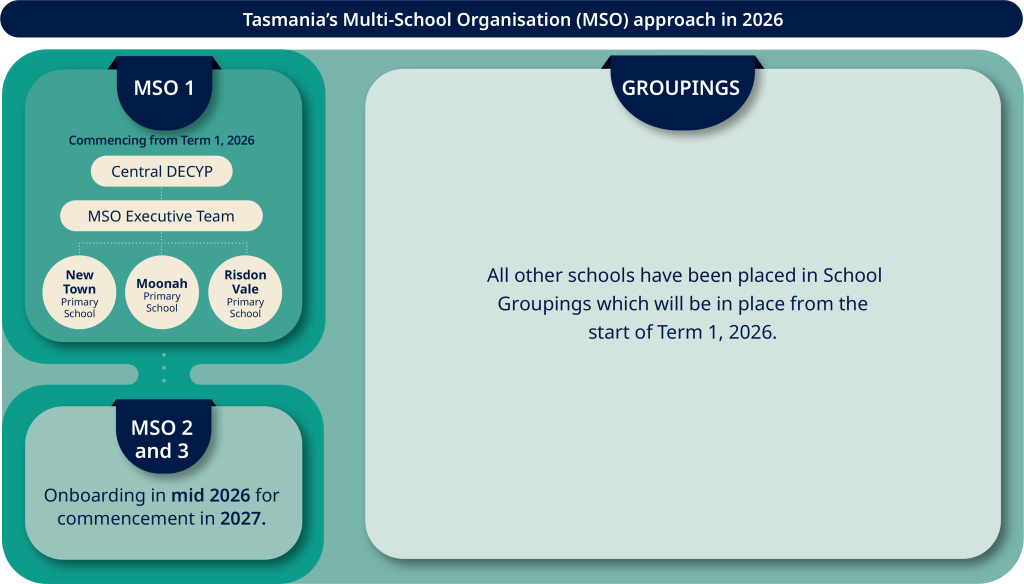
- Three schools will come together as part of the first MSO: New Town Primary School, Moonah Primary School, Risdon Vale Primary School
- All other schools will work together in School Groupings, getting ready to be part of an MSO in the future.
What is a Multi-School Organisation (MSO)?
MSOs are ‘families’ of schools that are bound together through a united leadership team that is accountable for student results.
Schools in an MSO act collectively and have tight alignment across curriculum, teaching and operations, while maintaining their individual identities and community ties.
An MSO’s size and ability to pool resources allows it to provide targeted and effective assistance to each school in its family. It increases support for teachers and leaders to deliver consistent improvements in student outcomes.
MSOs are designed to support close, formal relationships between schools to enable purposeful collaboration.
MSOs are inspired by the successful Multi-Academy Trust model in England and evidence from the Grattan Institute on adapting the model for Australia.
Benefits from being part of an MSO
- Students: MSOs have emerged internationally as a powerful mechanism to improve student engagement and learning. Students will get the best possible start in life through learning supported by strong school communities and the collective expertise of staff from across the MSO. The MSO will complement the results achieved through the lifting literacy initiative as well as the focus on numeracy by supporting high quality teaching and a common curriculum.
- Teachers: Reduced lesson planning and administrative duties, freeing up more time for teaching, supporting students with additional needs and professional development
- School leaders: Reduced administrative burdens, enabling a greater focus on leadership and community engagement. School leaders will have increased professional development, a broader peer network to collaborate with and increased access to mentoring.
- Parents: Schools will be better supported to provide high-quality education and address barriers to learning.
Tasmanian MSO approach
Three Tasmanian schools will take part in the first MSO from Term 1, 2026:
- New Town Primary School
- Moonah Primary School and
- Risdon Vale Primary School.
The first MSO will expand steadily throughout the trial, with more schools being added.
It is intended that two more MSOs will be onboarded during the second half of 2026 for commencement in 2027.
All other schools have been placed in School Groupings which will be in place from the start of Term 1, 2026.
These groupings will deliver clearer reporting structures, create peer learning groups for educators, and provide greater accountability while preparing the foundations for the expansion of MSOs.
The MSO model and implementation approach is being carefully designed and will be built slowly through consultation and evaluation over the length of the trial.
The Department will continue to play a key role in:
- setting public expectations for schools
- holding schools accountable and
- providing support to schools on priorities, such as literacy and wellbeing.
To implement the MSO Trial, the department is working closely with McKinnon, an independent not-for-profit organisation with deep expertise in the MSO model.
Implementation of this reform will be independently evaluated and continuous improvements made to ensure the model works for our schools and communities.
At the heart of all everything we do is one simple goal: We want to ensure every child and young person in Tasmania has the best possible start in life and learning, supported by strong school communities.
What are School Groupings?
From Term 1 2026, every school that is not part of the MSO trial will be placed in a grouping of schools, under the shared leadership of a highly experienced senior Principal called an Executive Lead.
This is an opportunity for schools to collaborate and learn from each other across teaching and learning, wellbeing and school operations, under the shared guidance of a highly experienced Principal.
These Groupings will deliver clearer reporting structures, create peer learning groups for educators, and provide greater accountability while preparing the foundations for the expansion of Multi-School Organisations over time.
There will be 11 School Groupings across Tasmania. View the 2026 School Groupings list (PDF, 162 KB).